
1 inch graph paper (1" squares)
One-inch graph paper has a single square per inch. Tabletop gamers print it as a battle map—one square is five feet in most role-playing games—and teachers use it for area, perimeter and very early math.
Print at 100% / Actual size so the squares measure exactly. Printing help
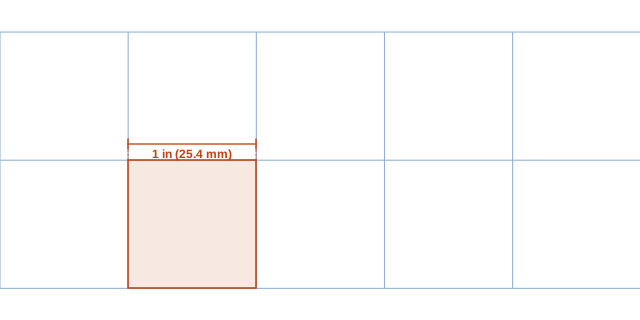
What it looks like up close
Ready-made PDF downloads
Prefer a file you can save and print later? These use the default settings shown above.
How many squares per page
Each square is 1 in (25.4 mm). With the default margin, a sheet holds:
| Paper | Portrait (across × down) | Landscape (across × down) |
|---|---|---|
| US Letter | 8 × 10 | 10 × 8 |
| A4 | 7 × 11 | 11 × 7 |
| US Legal | 8 × 13 | 13 × 8 |
| Tabloid 11×17 | 10 × 16 | 16 × 10 |
| A3 | 11 × 16 | 16 × 11 |
Example: a battle map
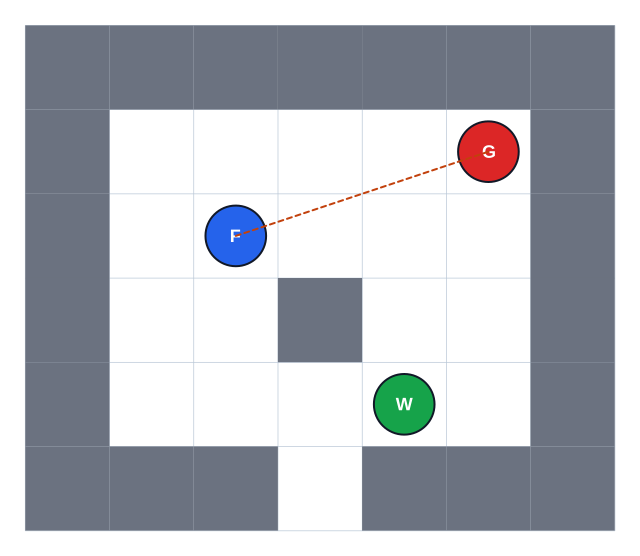
The fighter (F) is three squares from the goblin (G) diagonally, which most rule sets count as 15 feet. The pillar blocks line of sight across the middle of the room, and the doorway in the south wall is one square wide. Shading walls in gray makes the playable floor easy to see at a glance.
Battle maps and miniatures
Standard 25–28 mm miniatures stand on one-inch bases, so a one-inch grid is the native scale for Dungeons & Dragons, Pathfinder and many wargames. A Letter sheet holds 8 × 10 squares; tape several together, or choose Tabloid (11 × 17 in) for a 10 × 16 map from a single page.
Print with a light color so dry-erase or pencil drawings stand out, or print on cardstock and laminate it for a reusable map.
Classroom and crafts
Young children count squares to find area and perimeter, build bar graphs with stickers, and cut the grid into tiles. Quilters draft blocks on it at one square per inch, and sign makers use it to scale up drawings by the grid method.
Need more squares? Try 1/2 inch or hexagon paper for hex-based games.
Scaling a picture with the grid method
To enlarge a drawing, draw a light grid of small squares over the original, then copy each square's contents into the matching one-inch square. A 1/4 inch grid over the original and one-inch squares on the copy enlarges the picture four times. Murals, signs and embroidery patterns are scaled up this way.
Because each square is so large, the method works well with children too: they only need to copy simple lines one square at a time.
How to make a quick battle map
- Print one-inch paper in a light color, or on Tabloid / A3 for a bigger area.
- Sketch the outline of the room or cave in pencil along grid lines.
- Shade walls and obstacles so the open squares stand out.
- Mark doors, traps and terrain with simple symbols and a small key.
- Laminate the sheet or put it in a sheet protector to reuse it with dry-erase markers.
Large squares for area and perimeter
One-inch squares are big enough for young children to count with a finger. Ask them to draw a shape with an area of 12 squares in as many different ways as they can, then compare perimeters: a 3 × 4 rectangle has a perimeter of 14, while a 2 × 6 rectangle has 16.
Compare with nearby sizes
Squares per page with 1/4 inch margins, portrait. All sizes are compared on the home page.
| Grid | Square (in) | Square (mm) | US Letter | A4 |
|---|---|---|---|---|
| 1 cm | 0.394 | 10 | 20 × 26 | 19 × 28 |
| 1/2 inch | 0.5 | 12.7 | 16 × 21 | 15 × 22 |
| 1 inch | 1 | 25.4 | 8 × 10 | 7 × 11 |
Questions
Is 1 inch graph paper the right size for D&D?
Yes. Miniature bases are one inch, and one square represents 5 feet in D&D 5e.
How many 1 inch squares fit on 8.5 × 11 paper?
8 × 10 squares with 1/4 inch margins. Most printers cannot print to the edge, so a full 8.5 × 11 grid is not possible.
Can I print a bigger map?
Choose Tabloid (11 × 17 in) or A3, or print several Letter pages and tape them along the grid lines.
Can I print a 1 inch grid without margins?
Most printers cannot print to the paper edge, so a margin is needed. Set it as small as your printer allows, typically 1/8 to 1/4 inch.
How do I join several sheets?
Trim the margin on one side of each sheet and tape the pages so the grid lines continue across the join.