
Isometric graph paper
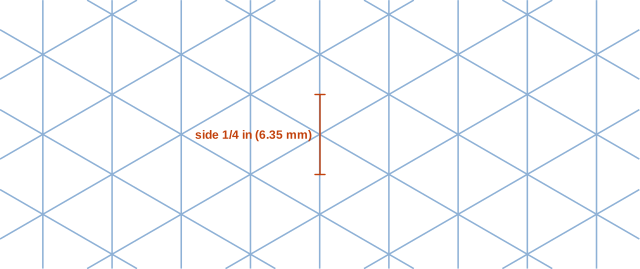
Isometric paper is a grid of equilateral triangles: vertical lines plus two sets of lines at 30° to the horizontal. Drawing along them produces isometric projections, where width, depth and height are all shown at the same scale.
What it looks like up close
Ready-made PDF downloads
Prefer a file you can save and print later? These use the default settings shown above.
Example: an L-shaped block
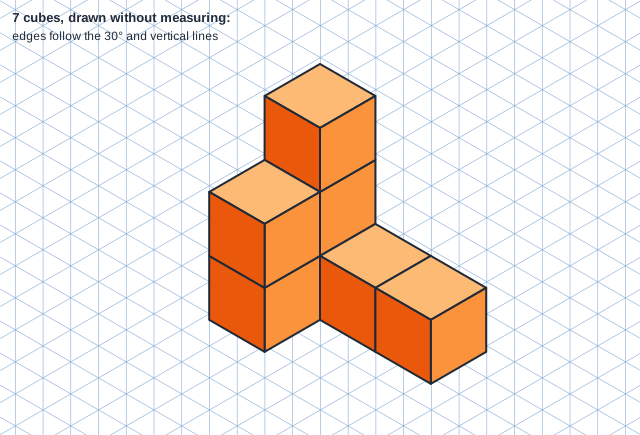
Shading the three visible faces—top light, left medium, right dark—makes the drawing read as solid immediately. Count cubes along each direction: three along the bottom right, two along the left and three up the tallest column. Hidden cubes are implied: the stack at the back must be supported from below.
Drawing 3D objects on an isometric grid
Start with a vertical edge, then follow the 30° lines to the left and right for the other two dimensions. A box 3 × 2 × 4 units is three triangles along one diagonal, two along the other and four up the vertical—no measuring or angles needed.
Engineers and product designers use isometric sketches to explain parts; game artists use the grid for pixel-art buildings; students use it in technology and design lessons.
Choosing triangle size
The spacing setting is the side length of each triangle. 1/4 inch or 5 mm suits most sketches; 1/2 inch or 1 cm is better for younger students and building-block drawings. The distance between parallel lines is the side × 0.866.
Prefer dots? Isometric dot paper uses the same lattice with dots only.
Isometric versus perspective drawing
In isometric drawing parallel edges stay parallel and all three axes keep the same scale, so you can measure directly from the sketch. Perspective drawing makes objects look more realistic by shrinking distant parts, but measurements are lost. That is why technical sketches, assembly instructions and many video games use isometric views.
Circles in isometric view become ellipses. Draw the circle's square outline as a rhombus on the grid first, then fit the ellipse inside it, touching the middle of each side.
Isometric grids in games and design
Many classic and modern video games use isometric tiles: a square floor tile appears as a diamond twice as wide as it is tall. Sketching levels on isometric paper first makes it easy to plan walls, stairs and heights before building them digitally.
Interior designers and model builders sketch rooms and furniture the same way, because a single drawing shows floor area and height together.
How to draw a box in isometric
- Pick a lattice point for the nearest bottom corner.
- Draw the vertical edge up for the height.
- From the bottom corner, follow the 30° lines left and right for depth and width.
- Complete the top face as a rhombus parallel to the bottom edges.
- Darken visible edges and shade the faces to show which way they point.
Dimensions on isometric drawings
Because all three axes use the same scale, a dimension can be written along any isometric edge. Draw dimension lines parallel to the edge they measure, with extension lines along the lattice. Edges that are not parallel to an axis—slopes and chamfers—are drawn by locating their end points on the grid and joining them.
Recommended settings
Starting points for common uses. Pick the closest one, then adjust the size or color in the generator above.
| Use | Settings |
|---|---|
| Technical sketches | 1/4 inch or 5 mm triangles, light blue |
| Beginners and young students | 1/2 inch or 1 cm triangles |
| Pixel-art buildings and game levels | 5 mm triangles, landscape |
| Large drawings for display | Tabloid or A3, 1/2 inch |
Questions
What angle are the lines on isometric paper?
Vertical lines plus lines at 30° and 150° to the horizontal, forming equilateral triangles with 60° angles.
What is the difference between isometric and graph paper?
Graph paper has square cells for flat (2D) drawings; isometric paper has triangles for drawing three-dimensional objects.
Can I turn the grid so lines are horizontal?
Switch the page to landscape and rotate the printed sheet, or print as is—the lattice is symmetric.
Is isometric paper the same as triangle graph paper?
Yes, an isometric grid divides the page into equilateral triangles.
What size triangles should I use?
1/4 inch or 5 mm for detailed sketches; 1/2 inch or 1 cm for beginners.