
Graph paper PDF generator
Make printable graph paper in seconds. Pick the square size, page size and colors, then download a vector PDF or print it straight away. Everything runs in your browser—free, no sign-up, no watermark.
Print at 100% / Actual size so the squares measure exactly. Printing help
Graph paper by square size
Each page opens the generator with that grid already set up, plus ready-made Letter and A4 PDFs.
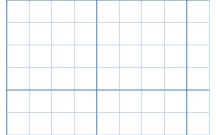 1/4 inch1/4 inch graph paper (4 squares per inch)
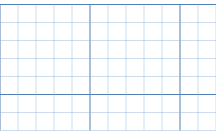 5 per inch5 squares per inch graph paper (5×5)
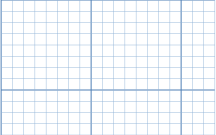 1/8 inch1/8 inch graph paper (8 squares per inch)
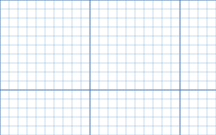 10 per inch10 squares per inch graph paper (1/10 inch)
 1/2 inch1/2 inch graph paper (large squares)
 1 inch1 inch graph paper (1" squares)
 1 cm1 cm graph paper (centimeter grid)
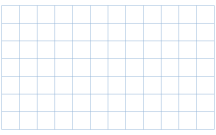 5 mm5 mm graph paper (squared paper)
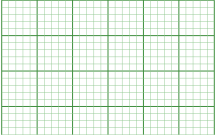 2 mm2 mm graph paper
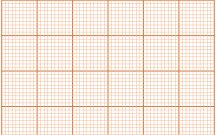 1 mm1 mm graph paper (millimeter paper)
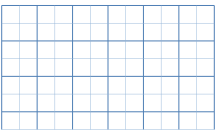 A4A4 graph paper
Other kinds of grid paper
 Dot gridDots instead of lines: the structure of graph paper without the clutter. Popular for bullet journals, lettering and UI sketches.
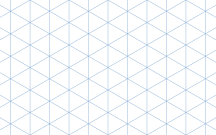 IsometricEquilateral triangles for drawing 3D objects in isometric projection—boxes, parts, buildings and game levels.
 Isometric dotsThe isometric lattice as dots, used in math lessons on cube structures and 3D views.
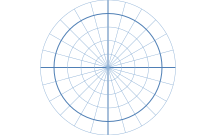 PolarConcentric circles and rays for polar coordinates, angles, bearings and circular designs.
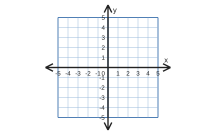 Coordinate planeA grid with numbered x and y axes in four quadrants, printed one to six per page for homework and quizzes.
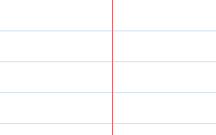 Lined paperWide, college or narrow ruled writing paper with a red margin and an optional name and date header.
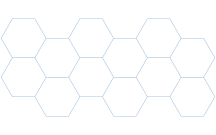 HexagonHexagonal cells for war-game and RPG maps, organic chemistry rings and quilt layouts.
 EngineeringThe green five-squares-per-inch computation pad used for engineering homework and calculations.
Which graph paper should I print?
Start from what you will do on the paper. Writing numbers needs squares big enough for a digit; drawing to scale needs a grid that matches your units; plotting precise data needs a fine grid with bold lines to count by.
| Grid | Typical use |
|---|---|
| 1/4 inch (4 per inch) | US school math, floor plans at 1/4" = 1 ft, general sketching |
| 5 per inch / engineering | Engineering homework, data plots with decimal scales |
| 10 per inch | Precise science graphs |
| 1/2 inch, 1 inch | Young children, large handwriting, tabletop battle maps |
| 5 mm | Notebook grid in Europe and Asia, bullet journals |
| 1 cm | Area and perimeter, metric scale drawings |
| 2 mm, 1 mm | GCSE / lab graphs, engineering drawings |
| Coordinate plane | Plotting points and graphing equations in four quadrants |
| Isometric | 3D sketches, technical drawing |
| Polar | Polar equations, angles and bearings |
Graph paper sizes at a glance
How many whole squares fit on a page with 1/4 inch margins, portrait orientation. Landscape swaps the two numbers (give or take one square).
| Grid | Square (in) | Square (mm) | US Letter | A4 |
|---|---|---|---|---|
| 1/4 inch | 0.25 | 6.35 | 32 × 42 | 31 × 44 |
| 5 per inch | 0.2 | 5.08 | 40 × 52 | 38 × 55 |
| 1/8 inch | 0.125 | 3.18 | 64 × 84 | 62 × 89 |
| 10 per inch | 0.1 | 2.54 | 80 × 105 | 77 × 111 |
| 1/2 inch | 0.5 | 12.7 | 16 × 21 | 15 × 22 |
| 1 inch | 1 | 25.4 | 8 × 10 | 7 × 11 |
| 1 cm | 0.394 | 10 | 20 × 26 | 19 × 28 |
| 5 mm | 0.197 | 5 | 40 × 53 | 39 × 56 |
| 2 mm | 0.079 | 2 | 101 × 133 | 98 × 142 |
| 1 mm | 0.039 | 1 | 203 × 266 | 197 × 284 |
What people use graph paper for
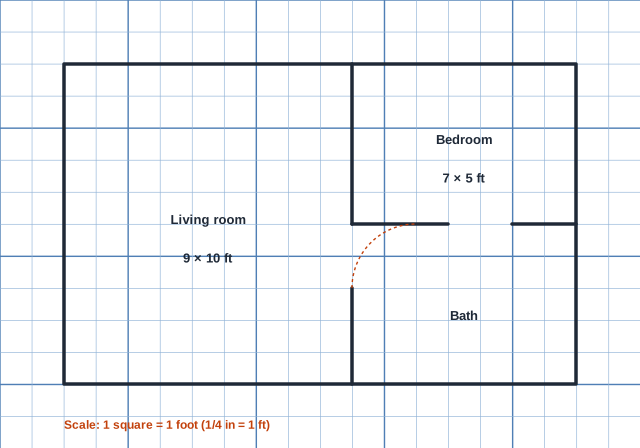
Scale drawings. Pick a scale—one square equals one foot, one meter or one stitch—and the grid does the measuring for you. Floor plans, garden beds, furniture, quilts and knitting charts are all drawn this way. See the 1/4 inch and 1/8 inch pages for worked examples.
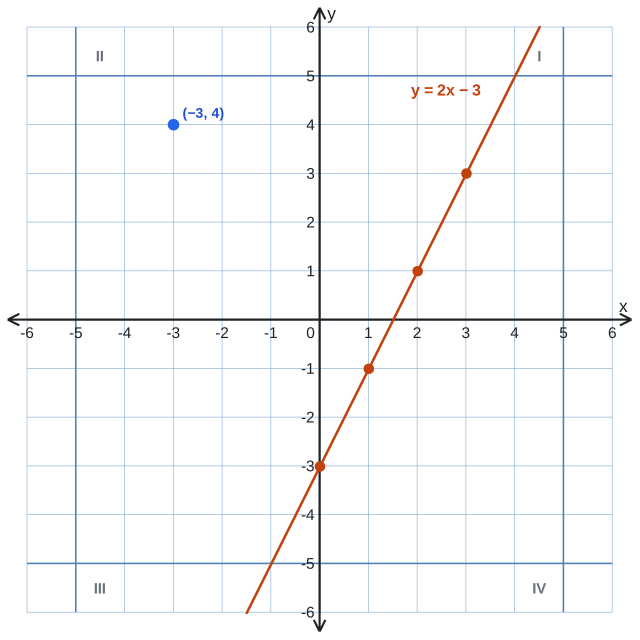
Math and science. Students plot points and functions on a coordinate plane, keep digits aligned in long multiplication on 5 mm squares, and draw lab graphs on 2 mm or 10 per inch paper where values must be read accurately.
Design and games. Designers sketch on dot grid, engineers explain parts with isometric drawings, and game masters draw dungeons on one-inch squares and wilderness on hex paper.
How the generator works
The page you see is drawn directly from your settings. The generator fits as many whole squares as the page allows inside the margin and centers them, so no square is cut off at the edges. Bold lines are counted from the edge of the grid, so with 1/4 inch squares and a bold line every 4 squares, every inch is outlined.
When you download, the same drawing is written into a PDF as vector lines—not a screenshot—so the file is small, prints sharp, and keeps exact dimensions. Choose up to 50 identical pages in one PDF to print a whole stack in one go. Nothing is uploaded: the PDF is built on your own device.
Tips for better graph paper
- Keep the grid light. Light blue, green or gray lines stay in the background; your pencil or ink should be the darkest thing on the page.
- Use bold lines for counting. A heavier line every inch, centimeter or 5 squares makes large distances quick to count.
- Match the page to the printer. Generate Letter PDFs for Letter paper and A4 for A4, so nothing is rescaled.
- Leave a margin. Most printers cannot print the outer 1/8–1/4 inch; the default margins already allow for that.
- Print a test page. Measure ten squares before printing a stack for a class.
Graph paper, dot grid or lined paper?
Graph paper is the best choice whenever position matters: drawings to scale, graphs, tables of numbers and diagrams. Dot grid gives the same structure with a cleaner look, which suits planners and sketches that will be shown to others. Lined paper is for continuous writing; it guides line height but not horizontal position. If you are unsure, print one sheet of each—the generator switches between them with a single menu.
Printing graph paper at the correct size
Printers and PDF viewers often shrink pages to fit the printable area. That makes 1/4 inch squares about 0.24 inch, which matters for scale drawings. In the print dialog choose Actual size, 100% or No scaling, then check with a ruler. Read the printing guide for step-by-step settings in Chrome, Edge, Safari and Adobe Acrobat.
A short history of graph paper
Grids were used for centuries by weavers and embroiderers to chart patterns, long before anyone plotted a graph. Coordinate geometry arrived with René Descartes' La Géométrie in 1637, which described positions by two distances from fixed lines. The first commercially published coordinate paper is usually credited to a Dr. Buxton of England, who patented paper printed with a rectangular grid in 1794. As science, engineering and school mathematics grew, printed grids in many rulings—millimeter, ten-to-the-inch, quad ruled—became everyday stationery.
Today the same grids can be printed on demand, in exactly the size and color you need, which is what this site is for.
Questions
Is this graph paper free?
Yes. Every PDF is free for personal and classroom use, with no watermark and no sign-up.
Why does my printed grid measure slightly small?
The print dialog is scaling the page. Choose “Actual size” or 100% instead of “Fit to page” and print again.
Are the PDFs vector files?
Yes. Lines are drawn as vectors, so the PDF stays sharp when zoomed and prints crisply on any printer.
What is the most common graph paper size?
In the US, 1/4 inch squares (4 squares per inch). Elsewhere, 5 mm squares on A4.
Can I print graph paper on A4 and Letter?
Yes. Choose the page size in the generator; squares keep their exact size and the number of squares adjusts to the sheet.
How many pages can I download at once?
Up to 50 identical pages in a single PDF. Set “Pages in PDF” before downloading.
Do I need to install anything?
No. The generator runs in any modern browser on a computer, tablet or phone, and works offline once the page has loaded.
Can I use the paper commercially?
Yes, you can print it for any use, including classes, workshops and client work. Please link to the site rather than re-hosting the files.