
Hexagon graph paper (hex grid)
Hex paper tiles the page with regular hexagons. Each cell has six neighbors at the same distance, which is why war games and role-playing campaigns use hex maps, and why chemists sketch ring structures on it.
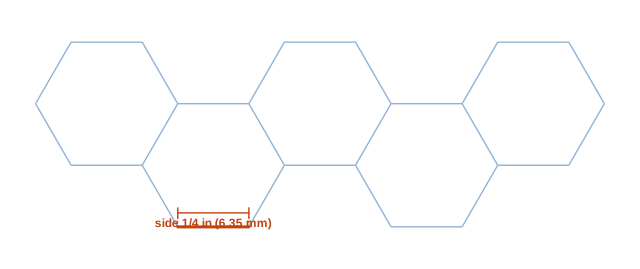
What it looks like up close
Ready-made PDF downloads
Prefer a file you can save and print later? These use the default settings shown above.
Example: an overland hex map
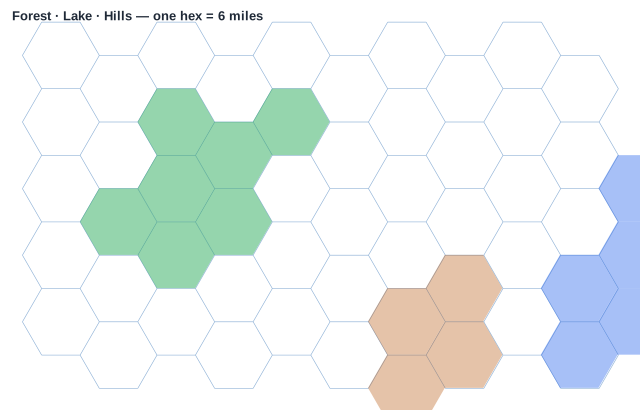
Terrain is filled in hex by hex, so travel times are easy to count: a party moving 24 miles a day crosses four clear hexes, or fewer through forest and hills. Rivers and roads can run along hex edges or through hex centers—pick one convention and stick to it.
Hex maps for games
Movement on a hex grid is the same in every direction, avoiding the diagonal problem of square grids. Wargamers use one hex per mile or per unit of movement, and many fantasy campaigns map wilderness travel in 6-mile hexes. Larger hexes (1 inch across the flats) fit miniatures; smaller ones suit overland maps.
Other uses
Organic chemistry students draw benzene rings and fused ring systems; quilters plan English paper piecing with hexagon templates; designers create honeycomb patterns and tile layouts.
The size setting is the length of one hexagon side; the hexagon is twice that from corner to corner. Related: isometric paper uses the same 60° geometry.
Measuring hexagons
A regular hexagon with side s is 2s from corner to corner and s × 1.732 across the flats. Its area is about 2.598 × s². Neighboring hex centers are s × 1.732 apart, which is the “movement” distance in hex games.
When printing a game map, decide on the scale first—for example, one hex equals 5 feet for tactical combat or 6 miles for overland travel—then pick a side length so the map you need fits on the sheet. Tabloid and A3 sizes give the most hexes per page.
Flat-top versus pointy-top layouts
Flat-topped hexes form vertical columns, which suits maps read from top to bottom and games where units move north and south along columns. Pointy-topped hexes form horizontal rows, which some players find easier for east–west movement. Printing in landscape and turning the sheet switches between the two without any other change.
Number hexes with a four-digit code—two digits for the column and two for the row—so locations can be written down in campaign notes.
How to draw a hex map
- Decide what one hex represents—5 feet, 1 mile or 6 miles.
- Mark the main features first: coast, mountains, rivers.
- Fill terrain types with colored pencils or symbols.
- Add settlements and points of interest in hex centers.
- Number the hexes along the edges so locations can be referenced.
Hexagons in chemistry and craft
Chemists draw benzene and other six-membered rings on hex paper so bond angles of 120° come out right without a protractor. Quilters plan hexagon quilts and English paper piecing layouts, coloring cells to test color arrangements before cutting fabric.
Recommended settings
Starting points for common uses. Pick the closest one, then adjust the size or color in the generator above.
| Use | Settings |
|---|---|
| Overland campaign map | Side 0.25 inch, Letter or Tabloid |
| Battle map for miniatures | Side 0.577 inch (1 inch across the flats) |
| Organic chemistry rings | Side 0.25 inch, light gray |
| Quilt planning | Side 0.4–0.5 inch |
Questions
What does the hex size setting mean?
It is the length of one side. A 1/4 inch side gives hexagons 1/2 inch from corner to corner and 0.43 inch across the flat sides.
Are the hexagons flat-topped or pointy-topped?
Flat-topped in portrait. Choose landscape and rotate the sheet for pointy-topped columns.
Can I print hex paper for a battle map?
Yes. Set the side to about 0.58 inch to get hexes 1 inch across the flats, then print on Letter or Tabloid.
Can I color the hexes before printing?
Not in the generator—print the blank grid and color it by hand, or import the PDF into a drawing program.
What hex size do war games use?
Board war games commonly use hexes from about 1/2 inch to just over 1 inch across.