
10 squares per inch graph paper (1/10 inch)
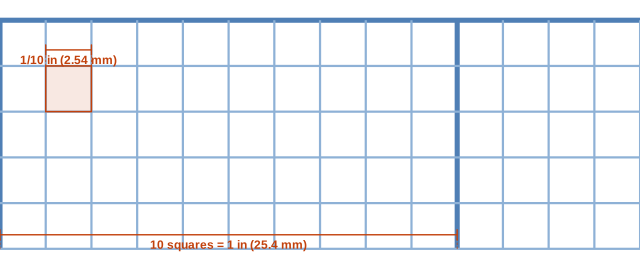
Ten-to-the-inch paper, sometimes called cross-section paper, has a 0.1 inch grid. Decimal scales read directly from it: every square is one tenth and every bold line is a whole unit.
Print at 100% / Actual size so the squares measure exactly. Printing help
What it looks like up close
Ready-made PDF downloads
Prefer a file you can save and print later? These use the default settings shown above.
How many squares per page
Each square is 0.1 in (2.54 mm). With the default margin, a sheet holds:
| Paper | Portrait (across × down) | Landscape (across × down) |
|---|---|---|
| US Letter | 80 × 105 | 105 × 80 |
| A4 | 77 × 111 | 111 × 77 |
| US Legal | 80 × 135 | 135 × 80 |
| Tabloid 11×17 | 105 × 165 | 165 × 105 |
| A3 | 111 × 160 | 160 × 111 |
Example: a calibration line
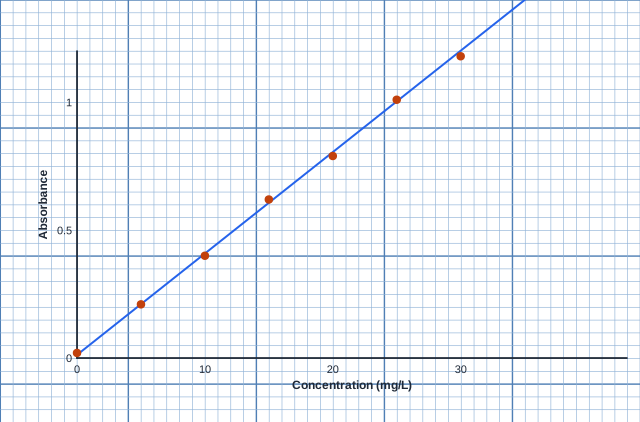
With one square equal to 1 mg/L and 0.05 absorbance units, an unknown sample's concentration can be read off the line to within a fraction of a square. Note that the points do not need to lie exactly on the line: a best-fit line balances the scatter above and below it.
Made for plotting measurements
Physics and chemistry labs ask for graphs that use most of the page and can be read to a fraction of a square. On 10-per-inch paper an 8 × 10.5 inch grid gives 80 × 105 squares, so a reading of 3.47 units is 34.7 squares from the origin—you can estimate the last digit by eye.
Draw the axes along bold lines, choose a scale of 1, 2 or 5 units per square (avoid 3), and label only the bold lines. Graph paper like this is also handy for drawing histograms and calibration curves.
Readability tips
Printed at 100%, the minor lines are only 2.54 mm apart, so the generator uses a very light line for them. If you want an intermediate guide, set the bold interval to 5 to get a heavier line every half inch.
For metric coursework, 1 mm graph paper and 2 mm graph paper are the equivalents used in the UK, Europe and Asia.
Choosing axis scales
Divide the range of your data by the number of squares available and round up to 1, 2 or 5 times a power of ten. For example, 0–37 seconds across 80 squares is 0.46 s per square; round up to 0.5 s, and each bold inch line is 5 seconds. Scales of 3 or 7 per square make every reading a mental division and are best avoided.
How to draw a best-fit line
- Plot every data point with a small cross.
- Hold a clear ruler so that roughly as many points lie above it as below it.
- Draw a single straight line across the whole range of the data.
- Pick two points on the line that are far apart and lie on grid intersections.
- Calculate the gradient as rise ÷ run using those two points, not the original data.
When to choose 10 per inch over millimeter paper
Use 10 per inch if your measurements or scale are in inches, or if your teacher hands out US-style lab worksheets. Use millimeter paper for metric work and for exam boards that specify it. The grids are close—0.1 inch is 2.54 mm—but they are not interchangeable when a drawing has to be measured with a ruler.
Compare with nearby sizes
Squares per page with 1/4 inch margins, portrait. All sizes are compared on the home page.
| Grid | Square (in) | Square (mm) | US Letter | A4 |
|---|---|---|---|---|
| 1 mm | 0.039 | 1 | 203 × 266 | 197 × 284 |
| 2 mm | 0.079 | 2 | 101 × 133 | 98 × 142 |
| 10 per inch | 0.1 | 2.54 | 80 × 105 | 77 × 111 |
| 1/8 inch | 0.125 | 3.18 | 64 × 84 | 62 × 89 |
| 5 mm | 0.197 | 5 | 40 × 53 | 39 × 56 |
Questions
What is 10×10 graph paper?
A grid with ten squares per inch (0.1 inch squares). It is sometimes sold as “cross-section” or “10 sq/in” paper.
Why are some lines darker?
Every tenth line (one inch) is bold so you can count large distances quickly. Change “Bold line every” to 5 for half-inch guides or 0 for none.
Will my printer reproduce such fine lines?
Most laser and inkjet printers do. If lines vanish, increase the line weight to 0.4 pt or choose a darker color.
What is cross-section paper?
A traditional name for graph paper with a fine regular grid, most often 10 squares per inch, used for plotting.
How many squares are on A4 at 10 per inch?
With 1/4 inch margins, 77 squares across and 111 down.