
1 mm graph paper (millimeter paper)
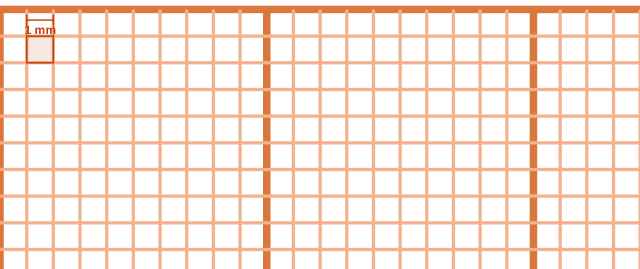
Millimeter paper shows every millimeter, with heavier lines every centimeter. Engineers, physics students and draftsmen use it when a graph or drawing has to be read to the nearest millimeter.
Print at 100% / Actual size so the squares measure exactly. Printing help
What it looks like up close
Ready-made PDF downloads
Prefer a file you can save and print later? These use the default settings shown above.
How many squares per page
Each square is 0.0394 in (1 mm). With the default margin, a sheet holds:
| Paper | Portrait (across × down) | Landscape (across × down) |
|---|---|---|
| US Letter | 195 × 259 | 259 × 195 |
| A4 | 190 × 277 | 277 × 190 |
| US Legal | 195 × 335 | 335 × 195 |
| Tabloid 11×17 | 259 × 411 | 411 × 259 |
| A3 | 277 × 399 | 399 × 277 |
Example: reading a half-life
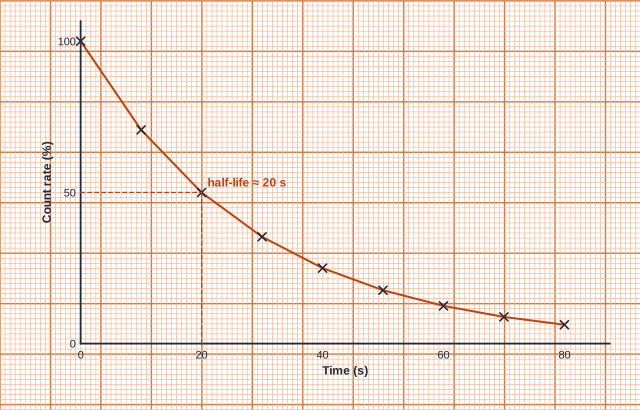
Go across from 50% on the count-rate axis to the curve, then straight down to the time axis: the half-life is about 20 seconds. The millimeter grid lets you place that reading to within half a second. Repeating the reading from 50% to 25% gives the same interval, which confirms the decay is exponential.
Reading millimeter paper
The bold lines mark centimeters; count whole centimeters first, then the millimeter lines inside. On a 190 × 277 mm grid (A4 with 10 mm margins) a value can be placed to within half a millimeter, about 0.2% of the page.
Millimeter paper is traditionally orange or green. The default here is orange; dark colors make the page look gray because the lines are so close together.
Uses
Physics labs use it for precise graphs and for finding gradients; engineering students draw sections and profiles; tailors and model makers draft patterns at full size. It is also known as papel milimetrado, papier millimétré and Millimeterpapier.
If your printer struggles with 1 mm lines, use 2 mm graph paper, which still has 1 cm bold lines.
Tips for accurate work on millimeter paper
Use a sharp pencil (0.5 mm or finer) and mark points with small crosses rather than dots so their centers stay visible. Draw axes on a centimeter line a couple of centimeters in from the edge, leaving room for labels and the scale.
When you need a gradient, pick two points on your line that are far apart and fall on grid intersections; the reading error is then a tiny fraction of the distance. Print a test page and measure 10 cm across the grid before printing a set—it should be exactly 100 squares.
How to read values precisely
- Find the value on one axis and follow a grid line to the curve.
- Mark the point where you meet the curve.
- Follow the perpendicular grid line to the other axis.
- Count whole centimeters from the bold lines, then the millimeters.
- Estimate a tenth of a square by eye for the last digit if needed.
Millimeter paper in other languages
Millimeter graph paper is “papel milimetrado” in Spanish and Portuguese, “papier millimétré” in French, “Millimeterpapier” in German and “carta millimetrata” in Italian. Worksheets in those languages that ask for it can be printed from this page on A4.
Compare with nearby sizes
Squares per page with 1/4 inch margins, portrait. All sizes are compared on the home page.
| Grid | Square (in) | Square (mm) | US Letter | A4 |
|---|---|---|---|---|
| 1 mm | 0.039 | 1 | 203 × 266 | 197 × 284 |
| 2 mm | 0.079 | 2 | 101 × 133 | 98 × 142 |
| 10 per inch | 0.1 | 2.54 | 80 × 105 | 77 × 111 |
Questions
Will a home printer print 1 mm lines accurately?
Yes, laser and inkjet printers place lines far more precisely than 1 mm. The size is only wrong if the print dialog scales the page—always print at 100%.
Can I add a line every 5 mm too?
The generator offers one bold interval. Choose 5 for 5 mm lines or 10 for centimeter lines.
What color is millimeter paper usually?
Orange, green or light blue. Pick any color in the generator.
Can I print millimeter paper on Letter?
Yes—choose US Letter; the squares stay exactly 1 mm.
Is there a version with 5 mm bold lines?
Set “Bold line every” to 5 to emphasize every 5 mm instead of every centimeter.