
Handwriting paper with a dashed midline
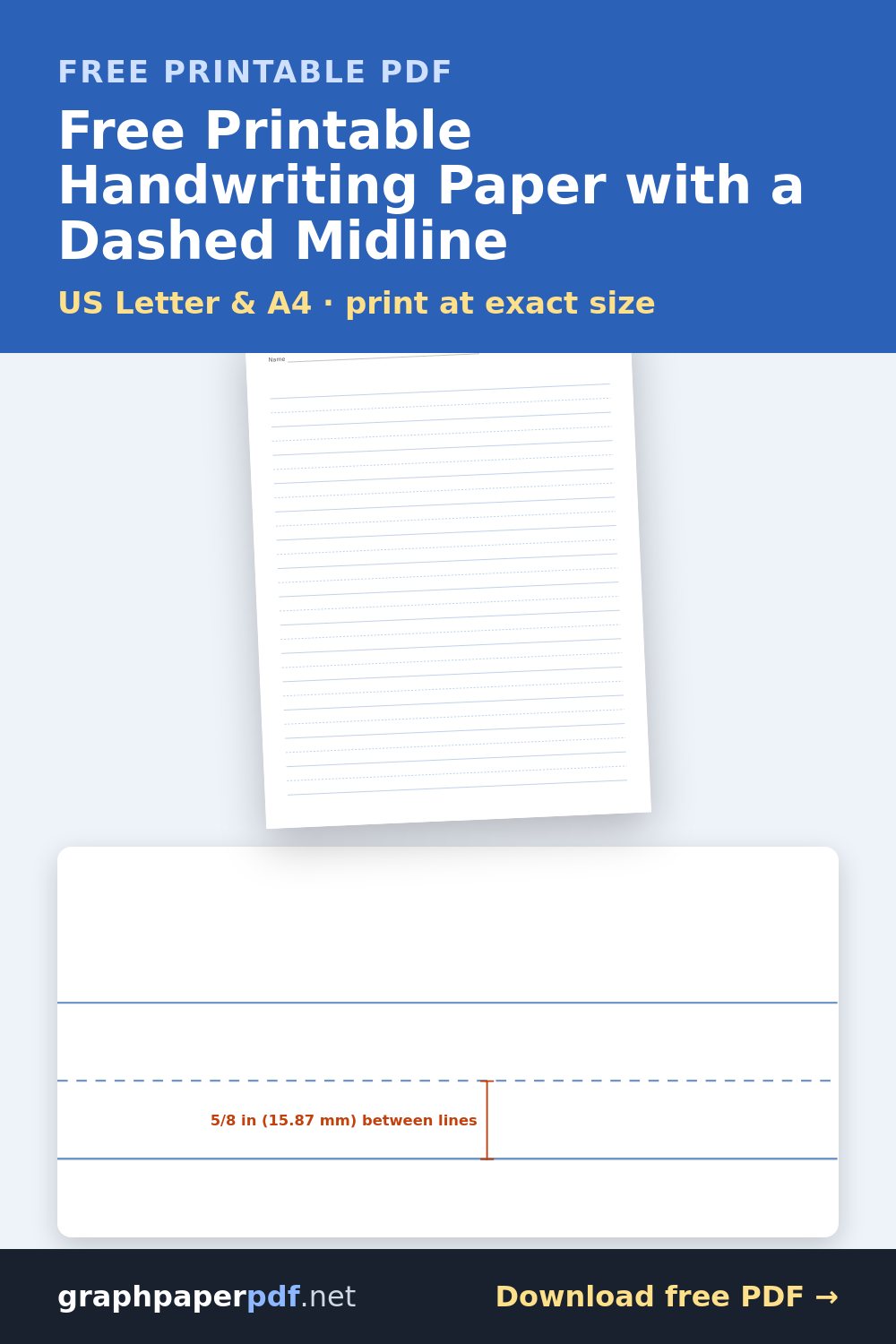
Handwriting paper—also called primary writing paper or dashed-line paper—has a solid top line, a dashed middle line and a solid baseline. The midline shows how tall lowercase letters should be, so children learn consistent letter sizes from the start.
Image for Word, Google Docs or note apps: ·
Print at 100% / Actual size so the squares measure exactly. Printing help
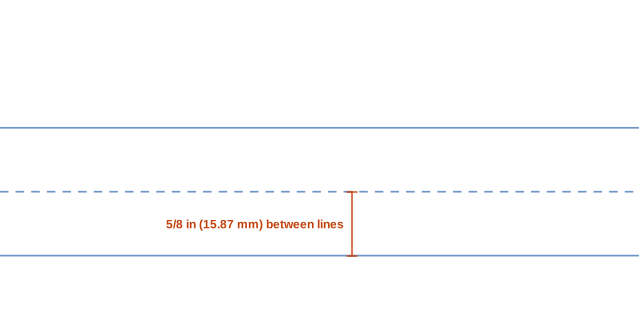
What it looks like up close
Ready-made PDF downloads
Default settings, ready to print.
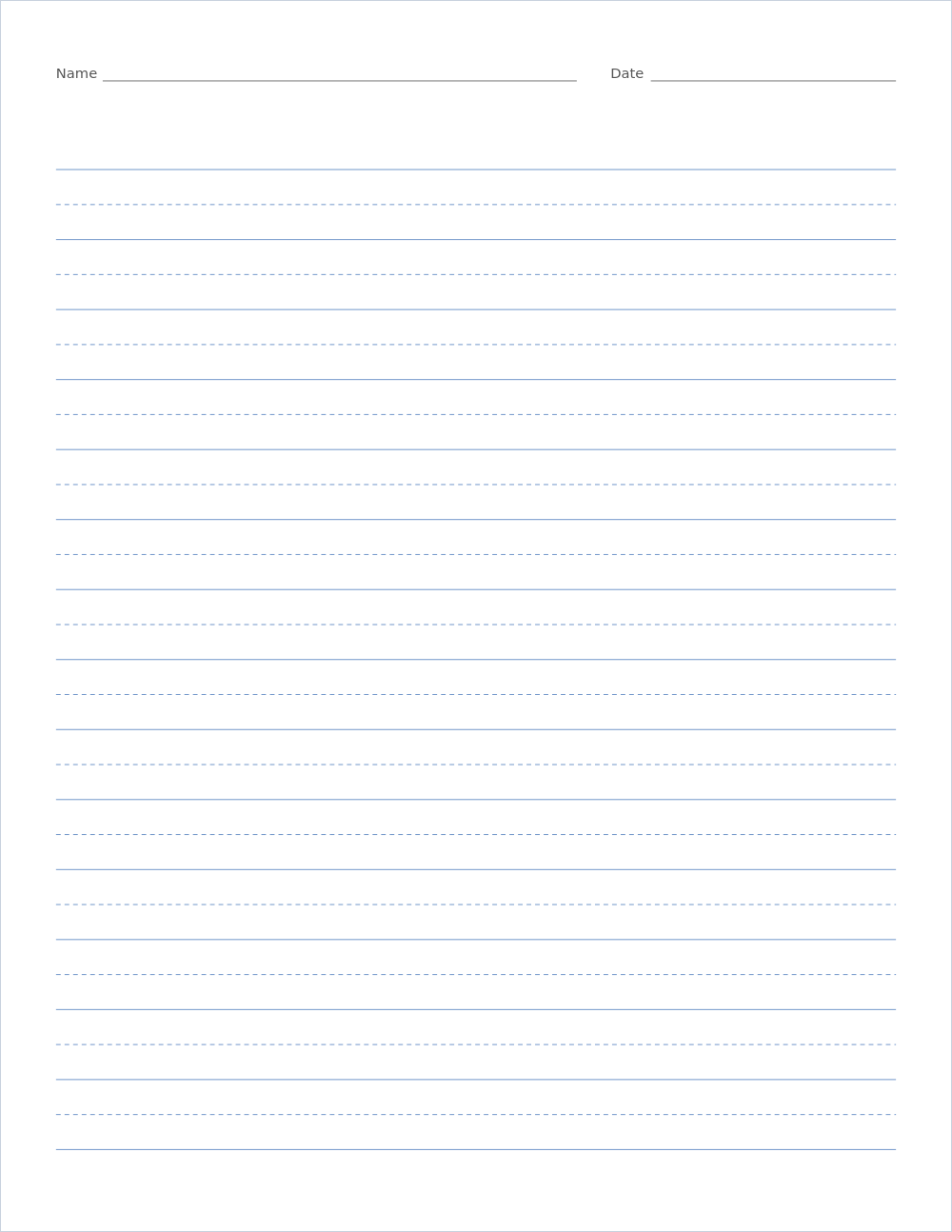
Handwriting paper pack (K–2)
Writing paper with a dashed midline and a name and date line: 1 inch, 3/4 inch, 5/8 inch and 1/2 inch lines, a landscape sheet, and wide ruled notebook paper for the next step.
7 pages · US Letter · PDF, 10 KB
Download the packExample: where letters sit on the three lines
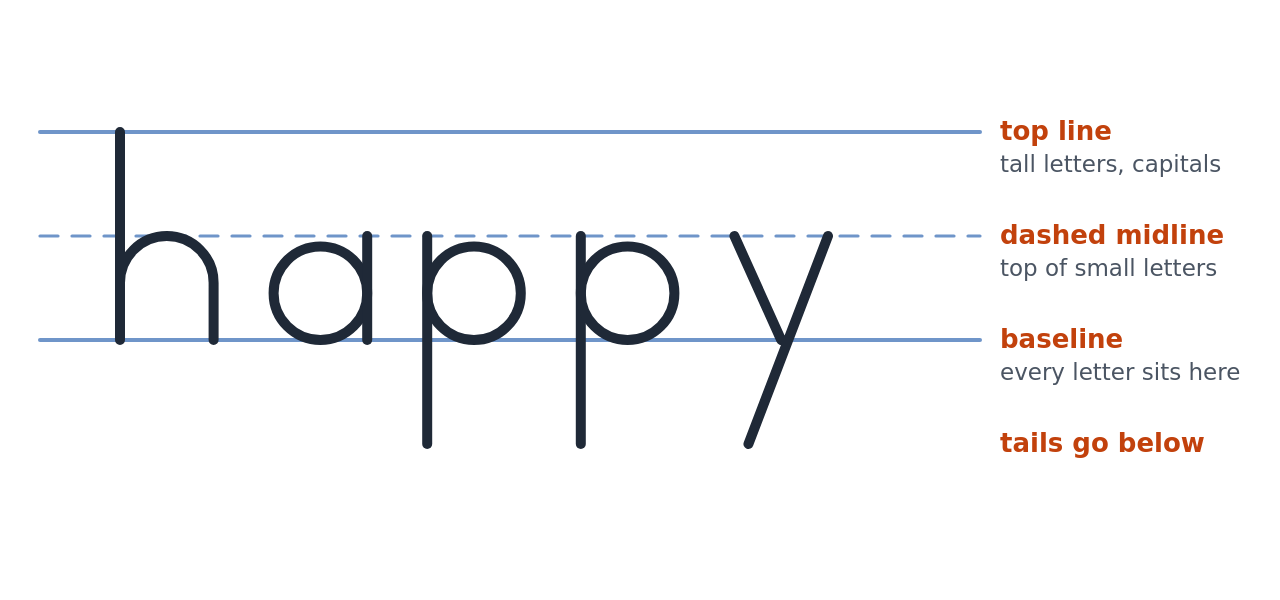
In the word “happy”, the h reaches the top line, a and the humps of p and y stop at the dashed midline, and the tails of p and y hang below the baseline. Pointing at the three lines while saying the letter's start point—“start at the top line, pull down to the ground”—is the core of most handwriting programs.
Which line size for which grade
Children's letters shrink as their fine motor control improves, so the spacing should shrink with them. A common progression is 1 inch for pre-K and early kindergarten, 3/4 inch for kindergarten, 5/8 inch for first grade, 1/2 inch for second grade and 3/8 inch for third grade, before moving on to wide ruled notebook paper. Every size is one click away in the presets above the preview.
Treat these as starting points rather than rules. A child who writes large and wobbly will do better one size up; one who is cramped can move down. Printing two sizes and letting the child choose is often the quickest way to find the right one.
How the three lines guide letter formation
Tall letters such as b, d, h, k, l and t start at the top line. Small letters such as a, c, e, m, o and s fit between the dashed midline and the baseline. Letters with tails—g, j, p, q and y—drop below the baseline into the space underneath. Capitals touch the top line.
Talking about the lines with names helps: many teachers call them the sky line, the fence (the dashed midline) and the ground, with the space below as the underground or “basement”. The dashed line is lighter on purpose, so it guides without competing with the child's pencil strokes.
Printing sheets for a class
Set the number of pages before downloading to get a whole set in one PDF—up to 100 pages. Turn the name and date line on for worksheets that are handed in, or off for a practice journal. Landscape sheets give fewer but longer lines, which young writers find less tiring for copying words.
Print at 100% (Actual size) so the line height matches the grade you picked. For copy work, write a model word at the start of the first line with a dark marker before photocopying the page.
How to print handwriting paper
- Pick a line size for the grade: 1 inch, 3/4, 5/8, 1/2 or 3/8 inch.
- Choose portrait, or landscape for fewer and longer lines.
- Turn the name and date line on or off.
- Set the number of pages for the whole class and download the PDF.
- Print at 100% so the line height matches the size you chose.
From handwriting paper to notebook paper
Most children stop needing the dashed midline around the end of second or third grade, once lowercase letters are a consistent size. The usual next step is wide ruled paper (11/32 inch), then college ruled in middle school. 3/8 inch handwriting paper makes a gentle bridge: its line height is close to the 11/32 inch of wide ruled paper, but it still shows the midline.
Recommended settings
Starting points for common uses. Pick the closest one, then adjust the size or color in the generator above.
| Use | Settings |
|---|---|
| Pre-K and early kindergarten | 1 inch, landscape |
| Kindergarten | 3/4 inch |
| First grade | 5/8 inch |
| Second grade | 1/2 inch |
| Third grade and cursive | 3/8 inch |
Questions
What size handwriting paper is used in kindergarten?
Usually 3/4 inch to 1 inch from top line to baseline, with a dashed midline. Many classes start at 1 inch and move to 3/4 inch during the year.
What is the dashed line in the middle called?
The midline (sometimes the “fence” or dotted line). It marks the top of lowercase letters such as a, c and e.
Is there a ready-made pack?
Yes—the handwriting paper pack below has 1, 3/4, 5/8 and 1/2 inch sheets, a landscape page and wide ruled paper in one PDF.
Can I get handwriting paper without the dashed line?
Yes—untick “Dashed midline” for plain wide lines; this is useful for older children who only need extra space.
Can I use it for cursive?
Yes. The same three lines guide cursive: loops reach the top line and most joining strokes sit on the midline. Many teachers use 1/2 or 3/8 inch for cursive practice.
Save it for later
 Pin this Handwriting paper to a board.
Save to Pinterest